Denmark: What Life Is Really Like in One of Europe’s Happiest Countries
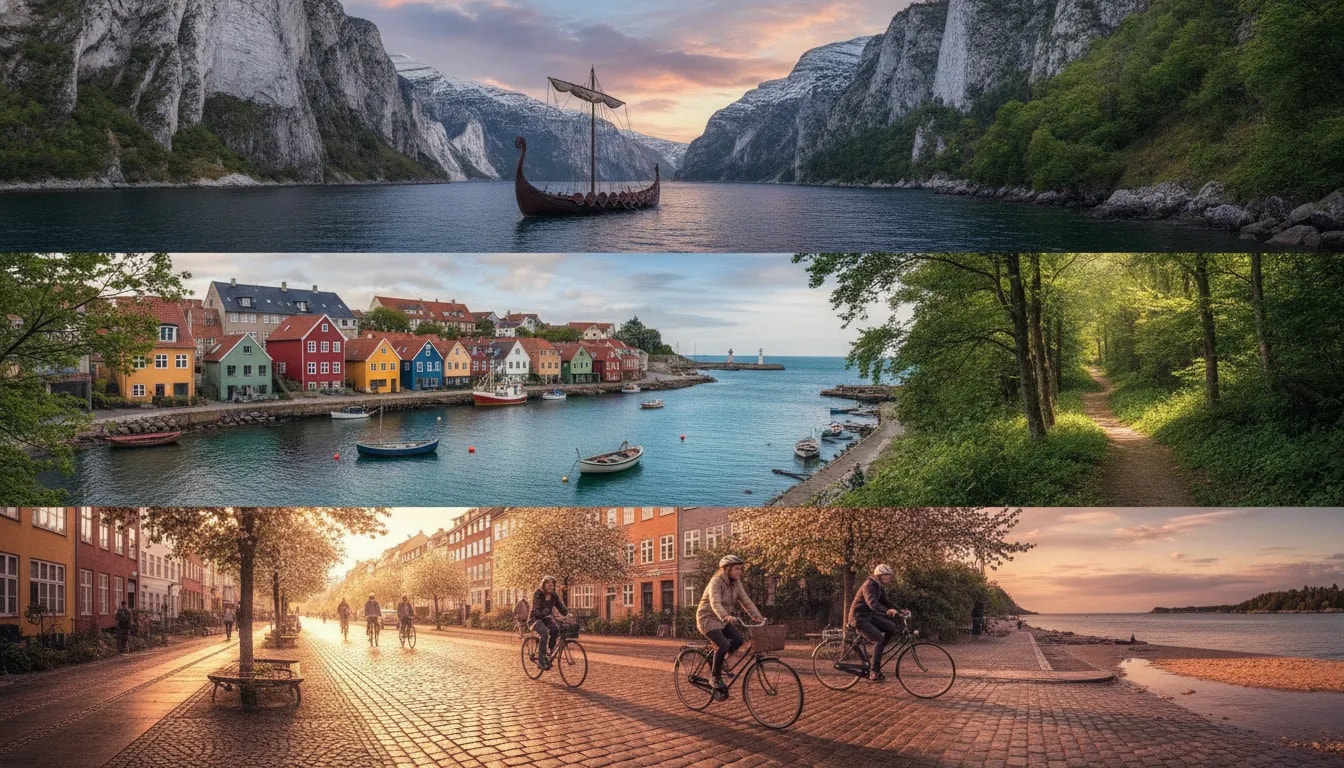
Denmark may be small on the map, but it has a remarkable ability to feel vast. One moment, there is a palace reflected in still water. The next, a wind-carved beach stretches so far that cars drive across the sand. There are Viking ships resting beside a fjord, white cliffs rising above the Baltic, colourful harbour houses, futuristic art, remote islands and a daily rhythm built around bicycles, good food and the quiet art of feeling at home.
This is not a country that overwhelms through scale. Its magic is subtler. Denmark reveals itself in details: a candlelit café, a clean cycle lane, an old castle on a lake, a trail through beech forest, a perfectly prepared open sandwich, or a sunset turning wet sand into gold.
- Denmark has just under 6 million inhabitants.
- It is frequently recognised as one of the world’s happiest countries.
- Its identity brings together Viking heritage, royal history, clean energy, sustainable design and a famously high quality of life.
- The landscape is shaped by hundreds of islands, long coastlines, fertile plains and a close relationship with the sea.
- There are more bicycles than cars, and even more pigs than people.
For anyone looking beyond Copenhagen, this is a country of surprising contrasts. Here are the places, landscapes and experiences that reveal Denmark at its most memorable.
🏙️ Copenhagen: Colour, Culture and Everyday Ease
Copenhagen is where Denmark’s past and present meet with effortless style. It is a city of royal palaces and old canals, but also bicycles, design, busy cafés and a rhythm that feels genuinely lived-in rather than staged.
Nyhavn and the historic harbour
Nyhavn is the classic Copenhagen image for good reason. Its narrow waterfront is lined with brightly painted 17th-century houses, wooden boats and outdoor tables facing the canal. Once a working commercial port, it has become one of the city’s most atmospheric places to slow down.
- What makes it special: Reflections of red, yellow, blue and orange façades ripple across the canal while bicycles pass along the quay.
- Literary connection: Hans Christian Andersen lived in Nyhavn and created some of the stories that would shape generations.
- Best approach: Treat it as a place to linger rather than simply photograph. The charm is in the boats, conversations, changing light and unhurried pace.
The Little Mermaid and Amalienborg Palace
Near the harbour stands the Little Mermaid, a modest bronze figure created in 1913. At just over one metre tall, it is far smaller than many expect, yet it remains one of Denmark’s most recognised symbols. Its melancholy and dreamlike mood reflects the enduring influence of Danish storytelling.
From there, Amalienborg Palace brings a more formal side of Copenhagen into view. The symmetrical palace complex is the official residence of the royal family, and the changing of the guard at midday is one of the city’s most precise daily rituals.
- The Little Mermaid: Small, symbolic and tied to Danish literary imagination.
- Amalienborg: A graceful royal square defined by symmetry, ceremony and history.
- Harbour walk: A simple way to connect these landmarks with Copenhagen’s waterside character.
Tivoli Gardens and Strøget
Copenhagen also understands how to preserve wonder. Tivoli Gardens has mixed vintage rides, gardens, lights and theatrical atmosphere since 1843. It is proof that nostalgia can still feel alive when it is cared for properly.
For city energy, Strøget offers a long pedestrian route filled with shops, architecture and street life. It is a place where the polished side of Scandinavian design meets the casual, sociable rhythm of the capital.
The Copenhagen mindset
The deeper appeal of Copenhagen is not just its landmarks. It is the way daily life seems deliberately designed around well-being. Cycling is not presented as an attraction. It is simply part of the city’s language. Public spaces invite people to sit, walk, gather and enjoy the outdoors.
That feeling is closely connected to hygge, the Danish idea of comfort, warmth and presence. Hygge is not a decorative trend. It is the pleasure of simple, meaningful moments: warm light, shared food, a quiet café and time without rush.
🌈 Aarhus: Denmark’s Creative Cultural Heart
West of the capital, Aarhus shows another face of Denmark. As the country’s second-largest city, it pairs a youthful energy with deep historical roots. Art, archaeology and contemporary architecture all coexist here with unusual ease.
ARoS Aarhus Art Museum
The city’s visual landmark is ARoS Aarhus Art Museum, crowned by the circular installation Your rainbow panorama by Olafur Eliasson. Walking through its coloured glass ring transforms the city skyline into an ever-changing spectrum.
- Signature experience: The panoramic rooftop installation turns Aarhus into a city viewed through colour.
- Collection: Contemporary art intended to provoke, enchant and challenge.
- Local icon: The museum is also known for its hyperrealistic sculpture of a giant boy.
Den Gamle By and Moesgaard Museum
Aarhus is not only about the future. Den Gamle By, the Old Town, is an open-air museum made of real buildings relocated from across Denmark. Its streets and houses represent periods from the 18th through the 20th centuries, creating a journey through changing Danish everyday life.
Then there is Moesgaard Museum, where archaeology becomes immersive. Its exhibitions reach from Viking history to the Grauballe Man, a body preserved in peat for more than 2,000 years. Aarhus makes the past feel present, not distant.
- Choose ARoS for contemporary creativity and panoramic city views.
- Choose Den Gamle By for historic streets and domestic life across the centuries.
- Choose Moesgaard Museum for Denmark’s ancient past, archaeology and Viking stories.
⚓ Roskilde: Royal Tombs and Viking Waters
Less than 40 kilometres from Copenhagen, Roskilde carries a historical weight far beyond its size. For centuries, it stood at the spiritual and political centre of Denmark. Its cathedral and fjord tell two very different but equally powerful stories: the story of monarchy and the story of seafaring explorers.
Roskilde Cathedral
Built in red brick in the 12th century, Roskilde Cathedral was the first Gothic cathedral in Scandinavia. It is now a UNESCO World Heritage Site and the burial place of more than 30 Danish monarchs.
Its richly decorated royal sarcophagi turn the building into a living record of Danish history. The atmosphere is quiet, solemn and deeply architectural, where every chapel and corridor seems to hold centuries of memory.
The Viking Ship Museum
On the Roskilde Fjord, the Viking Ship Museum brings Denmark’s maritime heritage into sharp focus. Five original Viking ships, recovered from the water in the 1950s, are preserved here with extraordinary care.
- Original ships: Five vessels reveal the construction methods and ambitions of Viking-age sailors.
- Living heritage: Replicas are built using techniques rooted in those used around 1,000 years ago.
- Immersive possibility: Sailing in a replica Viking boat offers a direct connection to the fjord and the ancient craft of navigation.
Roskilde is a reminder that Denmark’s identity was shaped by water. The fjord was not a boundary. It was a route into the world.
🌊 Skagen: Where Denmark Meets the Sea
At the northern tip of the Jutland Peninsula, Denmark seems to dissolve into sand, wind and open water. Skagen is a place of golden dunes, vast skies and a distinctive northern light that captivated painters in the 19th century.
The town has just over 8,000 residents, yet in summer it becomes a refuge for artists, writers and those searching for space. Yellow houses with red-tiled roofs, bicycles and sea air define its quiet personality.
Grenen and the meeting waters
The great natural spectacle lies at Grenen, Denmark’s northernmost point. Here, waves arrive from different directions and meet at the shifting sandspit. The result is a visible, hypnotic collision of currents that makes the edge of the country feel almost unreal.
- How to reach it: Follow the sandy trail or take the tractor train to the point.
- What to notice: The changing water colours, opposing waves and sense of standing at the edge of the continent.
- Skagen’s mood: Slow, windswept and beautifully unpolished.
Skagen is not about rushing between attractions. It is about letting the weather, light and horizon do the work.
🧱 Billund: The Birthplace of Boundless Imagination
Billund is a small town in central Jutland with a global legacy. In 1932, Ole Kirk Christiansen began making wooden toys here. In 1958, the familiar interlocking building brick was created, and a local workshop became the origin point of an international creative phenomenon.
- Population: Just over 7,000 people.
- Historical importance: A modest Danish town that changed childhood creativity around the world.
- Theme park: The resort beside the original factory opened in 1968.
- Scale: Its detailed models of landmarks, cities and daily scenes use more than 60 million bricks.
Billund works because it never treats imagination as something only children possess. Its bright streets, interactive zones and miniature worlds carry a strong sense of nostalgia, ingenuity and play.
🏝️ Bornholm: The Pearl of the Baltic
Bornholm feels like it belongs to another rhythm. Set apart from mainland Denmark in the Baltic Sea, this island is reached by ferry or plane, and that little bit of distance helps preserve its intact, quietly independent atmosphere.
It combines white sandy beaches, clear water, rocky coastlines, forests, fishing villages and a lively art scene. In the right light, it can feel almost Mediterranean, even though it rests in Northern Europe.
Beaches, villages and coastal character
- Sandvig, Dueodde and Balka: Names closely associated with beaches, clear skies and open sea.
- Gudhjem and Svaneke: Villages of sloping-roof houses, cafés and local creativity.
- Island atmosphere: Mild weather, transparent water and a pace that encourages wandering without a plan.
Hammershus ruins
Bornholm’s greatest historic landmark is Hammershus, a 13th-century fortress perched high above the sea. It is the largest medieval fortress in Scandinavia, and its ruins feel both powerful and exposed against the coastal landscape.
Walking among its weathered walls is like entering a forgotten Nordic chapter, where history is inseparable from cliff, wind and sea.
🤍 Møns Klint: Denmark’s White-Cliff Wonder
On the south-eastern edge of the island of Møn, Møns Klint rises with an almost impossible contrast: brilliant white chalk cliffs plunging into deep blue Baltic water. Reaching up to 120 metres high, the cliffs stretch for around seven kilometres and form one of Europe’s most dramatic natural landscapes.
This is not simply a beautiful coastline. It is a visible record of Earth’s deep past. The chalk began forming more than 70 million years ago from microscopic marine organisms that settled on the floor of a prehistoric ocean.
- Clifftop trails: Offer wide, cinematic views over the Baltic Sea.
- Staircase to the shore: Allows a close encounter with the ancient chalk at the base of the cliffs.
- Beech forest: Surrounds the coastline with dense green contrast, especially from May to September.
- Geocenter Møns Klint: Provides interactive context on fossils, ice ages and tectonic forces.
For geological information and practical context, the UNESCO Møns Klint biosphere reserve offers a useful introduction to this unique landscape.
🏰 Kronborg Castle: Hamlet’s Dramatic Setting
In Helsingør, on the north-eastern edge of Zealand, Kronborg Castle rises over the Øresund Strait. Built in the 16th century by King Frederick II, it was both royal residence and strategic toll station, placed to control one of northern Europe’s most important maritime passages.
It is also known around the world as the setting for Shakespeare’s Hamlet. The story of the troubled Prince of Denmark transformed this Renaissance fortress into one of literature’s most famous castles.
- Historic purpose: A symbol of royal power and a strategic maritime checkpoint.
- View: Sweden’s coastline lies only a few kilometres away.
- Interior atmosphere: Tapestries, stone floors, vast halls and corridors filled with echoes of court life and conflict.
- Legend: In the underground chambers rests Holger Danske, the warrior said to awaken should Denmark face grave danger.
Kronborg combines fact, folklore and theatre in one extraordinary setting. Few places make Denmark’s royal and maritime past feel so immediate.
🌉 The Øresund Bridge: A Link Between Two Countries
Between Copenhagen and Malmö, the Øresund Bridge is a powerful example of Scandinavian engineering with a human purpose. It connects Denmark and Sweden across the water, blending two cities, two cultures and countless daily routines.
- Bridge section: About eight kilometres.
- Tunnel section: A further four kilometres beneath the water.
- Why the design changes: The tunnel allows air traffic from Copenhagen Airport and maritime navigation to continue without interruption.
- Daily role: Tens of thousands of people cross by train or car.
It is more than transport infrastructure. It is a physical expression of connection, mobility and the practical imagination that runs through Danish design.
🌬️ Rømø: Wind, Sand and Wadden Sea Horizons
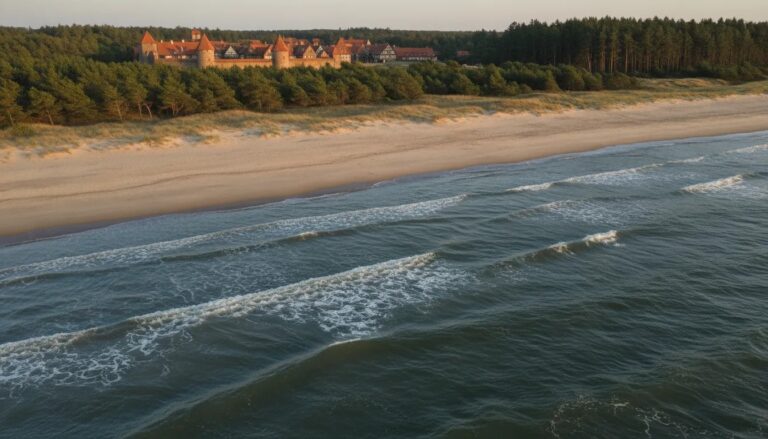
Rømø is an island connected to mainland Denmark by a road built across the sea. Here, the horizon feels enormous, the wind sets the terms and the beaches are so wide they resemble airstrips.
The island’s defining landscape is Lakolk Beach, where cars can drive directly onto the sand. It is a place of unusual freedom, where tiny figures and vehicles seem to disappear into the open space.
- Land sailing: Sail-powered vehicles race across the hard-packed sand.
- Kite festival: Between August and September, colourful kites transform the sky into a moving gallery.
- Protected setting: Rømø forms part of Wadden Sea National Park, a UNESCO World Heritage Site.
- Best moment: Sunset, when wet sand mirrors the orange and gold sky.
The Wadden Sea UNESCO World Heritage listing explains why this tidal landscape is internationally important.
🏯 Frederiksborg and Egeskov: Castles Reflected in Water
Denmark’s castles are not only historical monuments. They are part of the country’s visual imagination, often rising from lakes as though they were designed for reflection as much as defence.
Frederiksborg Castle in Hillerød
Frederiksborg Castle seems to float on the lake at Hillerød. Built in the early 17th century by King Christian IV, it is the largest Renaissance castle in Scandinavia. Spread across three small islands in Slotssøen Lake, it brings together towers, courtyards, grand halls and formal gardens.
- Today’s role: It has housed the Museum of National History since 1970.
- Highlights: Royal portraits, paintings, tapestries and the Chapel of the Order of the Elephant.
- Garden design: Baroque symmetry, fountains and long tree-lined paths.
Egeskov Castle on Funen
On the island of Funen, often considered Denmark’s green heart, Egeskov Castle rises from oak piles driven into a lake. Built in 1554, it is among Europe’s best-preserved Renaissance water castles.
- Exterior: Red brick, elegant towers and symmetrical windows reflected in water.
- Interior: Furnished rooms, hidden spaces and collections that include vintage cars and antique toys.
- Grounds: Flower beds, living mazes and hidden sculptures invite slow exploration.
Both castles reveal something essential about Denmark’s aesthetic: grandeur without unnecessary noise, beauty integrated with landscape, and history preserved as an experience rather than a relic.
🛶 Lake Arresø: Denmark at Its Quietest
After castles, coastlines and cities, Lake Arresø offers a different kind of Denmark. It is the country’s largest freshwater lake, covering more than 40 square kilometres and surrounded by forest and rolling fields.
This is a landscape for silence, paddles, birdsong and unhurried movement. In warmer months, daylight can last for more than 16 hours, extending the time for kayaking, sailing, stand-up paddleboarding or simply walking along the shore.
- Wildlife: Swans, otters, deer and many migratory bird species.
- Trails: Lead to viewpoints for birdwatching and peaceful lakeside walks.
- Historic detail: An early 18th-century canal still links Lake Arresø to Roskilde Fjord.
- Atmosphere: A place where nature sets the pace completely.
🥪 Danish Food, Hygge and the Meaning of a Good Life
Denmark’s appeal is never only about scenery. It is also about the emotional texture of daily life. The country’s food blends tradition and modern creativity, from smoked herring to acclaimed New Nordic cuisine.
The most recognisable everyday classic is smørrebrød, the open-faced sandwich. Built on rye bread and layered with ingredients such as fish, egg, meat or vegetables, it turns a simple meal into something generous, social and beautifully composed.
- Traditional flavours: Smoked fish, herring and rye bread remain deeply rooted in Danish food culture.
- Modern expression: New Nordic cooking has made local ingredients and seasonality central to contemporary Danish cuisine.
- Hygge in practice: Shared meals, warm cafés, candles, blankets and time spent fully present.
- Summer hygge: A quiet afternoon beside the sea, feet in the sand and no need to be anywhere else.
Hygge can be difficult to translate because it is less a thing than a feeling. It is comfort without excess, closeness without performance and enjoyment of the ordinary when it is given proper attention.
✨ Why Denmark Feels Different
Denmark’s lasting impression comes from its balance. It preserves Viking ships, Gothic cathedrals and Renaissance castles while also investing in clean energy, sustainable design and intelligent architecture. It can feel both ancient and forward-looking at the same time.
- History: Viking waters, royal tombs, medieval ruins and Shakespearean castles.
- Nature: Chalk cliffs, Baltic islands, immense beaches, forests and lakes.
- Design: Functional, thoughtful and rooted in everyday comfort.
- Culture: Creative cities, open-air history, contemporary art and food made for sharing.
- Quality of life: A sense that beauty, mobility, equality and well-being belong in ordinary routines.
Denmark is not merely a collection of pretty places. It is a country that makes a case for living with more presence. Its luxury is often quiet. Its beauty is often practical. Its most memorable experiences may be a castle, a cliff or a Viking ship, but the feeling that remains is simpler: balance, lightness and depth.
❓ Denmark Travel FAQ
What are the best places to visit in Denmark beyond Copenhagen?
Standout destinations include Aarhus for art and archaeology, Roskilde for Viking ships and royal history, Skagen for coastal landscapes, Bornholm for island life, Møns Klint for white chalk cliffs, Rømø for vast beaches, and Frederiksborg and Egeskov for Renaissance castles.
What is hygge in Denmark?
Hygge is the Danish feeling of warmth, comfort, connection and presence. It can be found in a candlelit café, a relaxed shared meal, a cosy home or a quiet moment outdoors.
Where can Viking history be explored in Denmark?
Roskilde is one of the best places for Viking heritage. The Viking Ship Museum displays five original Viking ships recovered from Roskilde Fjord and preserves the ancient boatbuilding traditions behind them.
What makes Møns Klint special?
Møns Klint is a seven-kilometre stretch of white chalk cliffs rising up to 120 metres above the Baltic Sea. Its chalk formed more than 70 million years ago and is surrounded by forest trails and geological exhibits.
Which Danish destination is best for castles?
Kronborg Castle in Helsingør is ideal for Shakespearean drama and maritime history, Frederiksborg Castle in Hillerød offers grand Renaissance architecture and formal gardens, and Egeskov Castle on Funen is a remarkably preserved water castle with extensive grounds.