Dubai’s Most Fascinating Wonders: A Bucket List of Luxury, Innovation and Adventure
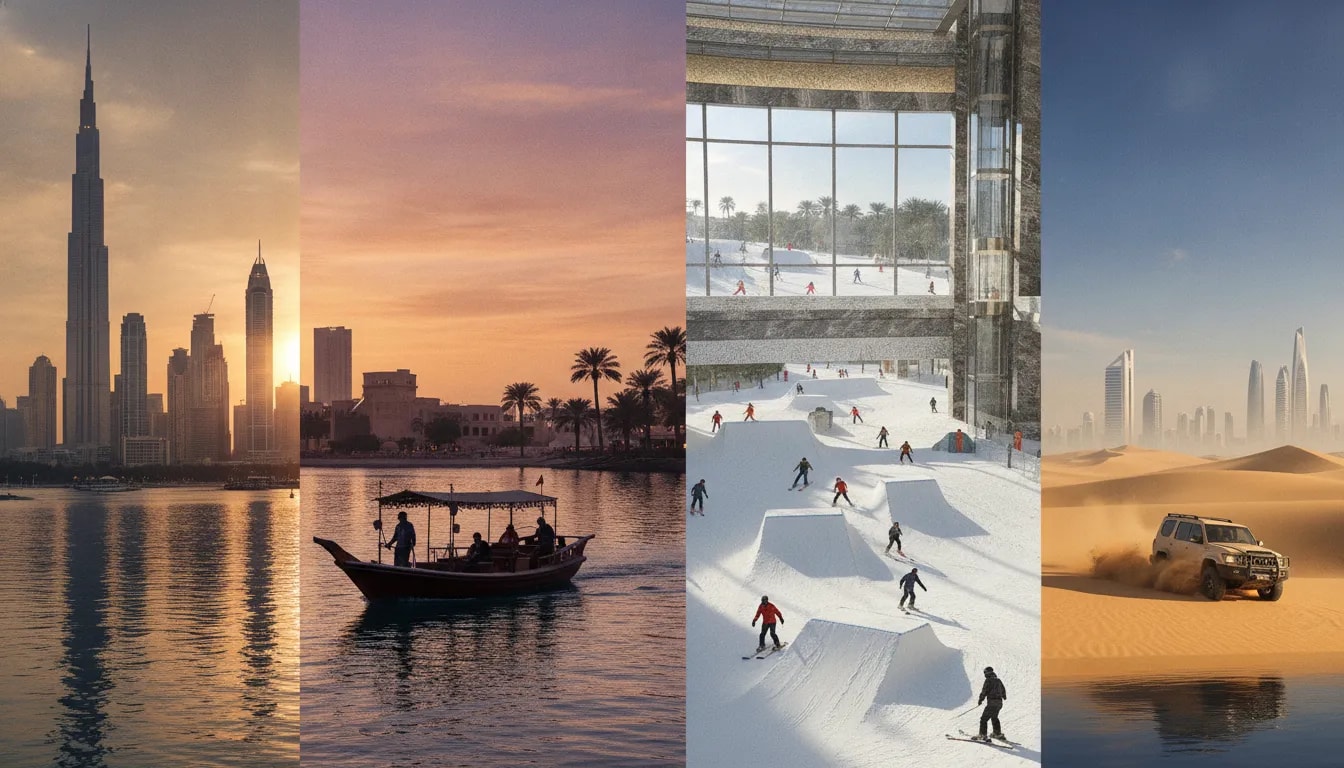
Dubai is a city built on contrast. In a single journey, it is possible to stand beneath the world’s tallest building, cross historic waters in a wooden boat, ski on real snow indoors, race through desert dunes, and admire islands shaped like palm trees floating in the Persian Gulf.
What began as a strategic trading hub has become one of the world’s most ambitious urban destinations. Oil played an important role in its early growth, but modern Dubai is powered by tourism, trade, finance, technology, logistics and an unmistakable ability to turn bold ideas into reality.
With a population of roughly 3.6 million people, most of whom come from abroad, Dubai has become one of the planet’s most cosmopolitan cities. Arabic is the official language, English is widely used in everyday life, and Emirati traditions coexist with food, cultures and communities from almost every corner of the world.
This is a place for anyone drawn to giant architecture, desert landscapes, old markets, skyline views, futuristic ideas and experiences that feel almost impossible.
Table of Contents
- 🏙️ Burj Khalifa: The Tower That Defines Dubai
- ⛲ Dubai Fountain: Water, Light and Music at Burj Lake
- 🕌 Sheikh Zayed Grand Mosque: Peace and Grandeur in Abu Dhabi
- 🌴 Palm Jumeirah: The Island That Reshaped the Coastline
- 🛍️ Dubai Mall: Much More Than Shopping
- 🔮 Museum of the Future: A Monument to What Comes Next
- 🖼️ Dubai Frame: Old Dubai and New Dubai in One View
- 🐪 Dubai Desert Safari: Adventure Beyond the Skyline
- 🛶 Dubai Creek and the Souks: Where the City Began
- ⛵ Burj Al Arab and Dubai Marina: Icons of Waterfront Luxury
- 🎢 Ferrari World Abu Dhabi and Ski Dubai: Extreme Contrasts
- 🏔️ Jebel Jais: The UAE’s High-Altitude Adventure
- ✨ Why Dubai Belongs on a Bucket List
- ❓ Frequently Asked Questions
🏙️ Burj Khalifa: The Tower That Defines Dubai
No Dubai bucket list begins anywhere else. Rising 828 metres above the city, the Burj Khalifa remains the tallest building in the world and one of humanity’s most remarkable engineering achievements.
- Height: 828 metres.
- Floors: More than 160 storeys.
- Opening year: 2010.
- Construction: More than 300,000 tonnes of concrete were used.
- Design inspiration: The structure draws inspiration from the Hymenocallis flower and incorporates elements influenced by Islamic architecture.
The Burj Khalifa is not simply a monument on the skyline. It functions like a vertical city, with luxury residences, offices, dining and the Armani Hotel all contained within its extraordinary height.
Its observation decks deliver one of the defining Dubai experiences. High-speed lifts rise to spectacular viewpoints, including the 148th floor, where the city spreads out below in every direction. On a clear day, the view extends across the Gulf, desert and distant coastline. Reaching such a height also creates the surreal possibility of seeing the sunset, descending, and catching it again from a lower point in the city.
For a more elevated dining experience, Atmosphere on the 122nd floor sits more than 400 metres above the ground. At night, the tower transforms again, becoming a massive illuminated canvas for light shows visible from far beyond Downtown Dubai.
- Best reason to go: To understand the scale of Dubai’s ambition in one unforgettable view.
- What makes it special: It combines engineering, architecture, luxury and skyline spectacle in a single landmark.
- Ideal pairing: Visit the observation deck before exploring the Dubai Fountain and Dubai Mall below.
⛲ Dubai Fountain: Water, Light and Music at Burj Lake
At the base of Burj Khalifa, Burj Lake becomes the stage for the Dubai Fountain, one of the city’s most recognisable evening experiences. The fountain is far more than a decorative feature. It is a carefully choreographed performance where powerful jets of water move in sync with music and light.
- Setting: Burj Lake, near Dubai Mall and Burj Khalifa.
- Lake size: About 30 acres.
- Lighting: More than 6,000 lights and 25 colour projectors.
- Water height: Jets can reach up to 150 metres.
- Performance schedule: Evening shows are generally held every 30 minutes.
The fountain’s water can rise as high as a 50-storey building, framed by the immense silhouette of Burj Khalifa. Each performance uses a different musical mood, moving between Arabic classics, opera and international pop songs.
The promenade around Dubai Mall is a prime place to enjoy the spectacle. For something quieter and more atmospheric, a traditional abra ride across the lake puts the reflections, music and moving water all around you.
It captures a signature Dubai formula perfectly: engineering turned into entertainment, luxury turned into a public experience, and a skyline turned into theatre.
🕌 Sheikh Zayed Grand Mosque: Peace and Grandeur in Abu Dhabi
A journey through the United Arab Emirates should extend beyond Dubai. In Abu Dhabi, the Sheikh Zayed Grand Mosque stands as one of the country’s greatest cultural and architectural landmarks.
Opened in 2007, this vast place of worship is the largest mosque in the United Arab Emirates and a powerful example of Islamic art, craftsmanship and openness. It welcomes people of different religions, inviting a respectful encounter with the beauty of Islamic architecture.
- Domes: 82 white domes rise across the complex.
- Capacity: More than 40,000 worshippers can gather here.
- Exterior: White marble reflects the changing daylight.
- Interior highlight: The main prayer hall contains the world’s largest hand-woven carpet.
- Another standout: A vast chandelier decorated with thousands of Swarovski crystals.
The mosque feels monumental, but its strongest quality is not merely its scale. The white marble, reflective pools, columns and courtyards create a sense of calm that is strikingly different from the energy of Dubai’s commercial districts.
When exploring the country’s iconic sites, this is the place to slow down, dress respectfully, and appreciate a more contemplative expression of the Emirates.
🌴 Palm Jumeirah: The Island That Reshaped the Coastline
Palm Jumeirah is one of Dubai’s clearest declarations that geography itself can be redesigned. Seen from the sky, this artificial archipelago forms the shape of a giant palm tree, with a central trunk, 17 fronds and a crescent-shaped outer breakwater.
- Construction began: 2001.
- Materials used: More than 100 million cubic metres of sand and 7 million tonnes of rock.
- Layout: A trunk, 17 fronds and a protective crescent.
- Transport: A monorail provides a scenic route across the island.
- Boardwalk: Approximately 11 kilometres of waterfront views.
The Palm is not just a piece of land reclaimed from the sea. It is an offshore neighbourhood filled with luxury residences, hotels, restaurants, beach clubs and wide views of the Dubai skyline.
At the outer end of the trunk, Atlantis The Palm is among its best-known landmarks. Its pink towers house hotel accommodation, a water park, an aquarium and underwater suites. The island can be explored by monorail, car or on foot along the boardwalk, but its full geometry becomes especially dramatic from above.
- For skyline views: Walk or cycle along the boardwalk near sunset.
- For the full palm shape: Choose a helicopter flight or skydiving experience.
- For an evening atmosphere: Explore the restaurants, nightlife and Palm Fountain area.
Palm Jumeirah proves that Dubai’s biggest projects are not limited to buildings. Here, the coastline itself became an architectural statement.
🛍️ Dubai Mall: Much More Than Shopping
Located beside Burj Khalifa, Dubai Mall is a destination in its own right. Opened in 2008 as part of the Burj Khalifa complex, it combines fashion, food, family attractions, entertainment and some of the city’s biggest indoor experiences.
- Total area: More than one million square metres.
- Shops: More than 1,200 stores.
- Entertainment: Aquarium, underwater zoo, ice rink, virtual reality attractions and cinema.
- Location: Directly beside Burj Lake, Burj Khalifa and the Dubai Fountain.
The standout attraction is the Dubai Aquarium and Underwater Zoo. Its huge tank contains more than 10 million litres of water and is home to more than 30,000 marine creatures, including sharks and rays. The glass tunnel creates the feeling of walking through an underwater world.
Dubai Mall also contains an Olympic-sized ice rink, a 22-screen cinema and VR Park, where virtual reality attractions add an unexpected layer of thrill to a day that might otherwise be spent shopping.
This is classic Dubai: a shopping centre transformed into an entertainment universe. Even if luxury shopping is not the main goal, the sheer range of experiences makes this area worth exploring.
🔮 Museum of the Future: A Monument to What Comes Next
Along Sheikh Zayed Road, the Museum of the Future immediately stands apart from the city’s angular towers. Its oval ring form, stainless-steel exterior and Arabic calligraphy make it one of the most striking buildings in Dubai.
- Height: 77 metres.
- Facade: More than 1,000 stainless-steel panels.
- Symbolism: The ring represents humanity, while the central void represents the unknown future.
- Calligraphy: Arabic inscriptions reflect a vision of innovation and progress.
Inside, the experience focuses on possibilities rather than historical objects. Its themes include artificial intelligence, robotics, biotechnology, space exploration, sustainability, future medicine, clean water and food security.
One of the most memorable concepts is a simulation of a space station in the year 2071. Other spaces imagine how science and technology could help respond to climate challenges and reshape daily life.
The museum is a reminder that Dubai does not treat the future as something distant. It approaches it as a design problem, an experience and an invitation to think bigger.
🖼️ Dubai Frame: Old Dubai and New Dubai in One View
The Dubai Frame is one of the city’s most literal symbols of contrast. This enormous golden structure acts as a portal between historic districts and the modern skyline.
- Height: 150 metres.
- Width: 93 metres.
- Lift journey: Approximately 75 seconds to the top.
- Key feature: A bridge with a transparent glass floor.
From the observation deck, the city divides into two visual stories. One direction leads toward old Dubai, including historic districts, souks and traditional neighbourhoods. The other leads toward wide avenues, glass towers and the distant Burj Khalifa.
The experience begins with an exhibition on Dubai’s transformation from Bedouin roots and commercial beginnings into a global metropolis. The final section looks ahead again, imagining how the city may evolve over the next 50 years.
For anyone trying to understand Dubai beyond its biggest skyscrapers, the frame provides a simple but powerful perspective: the past is still present, even when the future appears to dominate the horizon.
🐪 Dubai Desert Safari: Adventure Beyond the Skyline
Just outside the city, skyscrapers give way to open desert. The Arabian Desert is where another side of the Emirates becomes visible: rolling dunes, traditional Bedouin influences, sunsets in orange and red, and a sky filled with stars.
- Dune bashing: A high-energy 4×4 drive across steep dunes.
- Sandboarding: Riding down sandy slopes in a desert version of snowboarding.
- Camel rides: A slower way to experience the landscape and its traditional heritage.
- Bedouin camp experiences: Dinner, henna decoration and cultural performances.
- Evening atmosphere: Sunset views followed by stargazing.
Dune bashing is the headline thrill. Skilled drivers take 4×4 vehicles over sharp ridges and down steep slopes, often at dramatic angles. It is intense, fast and unlike city-based adventure.
For a different type of excitement, sandboarding lets you glide down the dunes. Camel rides create a more traditional connection to the desert, recalling the animals’ essential role in the life of the region for centuries.
As daylight fades, the experience shifts from adrenaline to atmosphere. Dinner under the stars, tanoura dance performances and henna designs turn the desert into a cultural setting as well as an adventure destination.
🛶 Dubai Creek and the Souks: Where the City Began
Dubai Creek is the historic heart of the city. This saltwater inlet divides Dubai into Bur Dubai and Deira and reflects the commercial life that existed long before the skyscrapers, artificial islands and luxury hotels.
An abra ride across the creek is one of the simplest and most meaningful experiences in Dubai. For only one dirham, these traditional wooden water taxis cross between the two sides, passing dhows, old buildings and the rhythms of a working waterway.
- Dubai Creek: The historic trading centre of the city.
- Abra crossing: A traditional wooden boat journey across the water.
- Spice Souk: Cinnamon, saffron, cloves, dates and aromatic ingredients.
- Textile Souk: Silk, fabrics, saris and colourful materials.
- Gold Souk: Hundreds of shops displaying an extraordinary range of gold jewellery.
The Spice Souk is a sensory experience, with fragrances and colours spilling from open displays. The nearby textile market is filled with fabric, embroidery and bright textiles. Then comes the Gold Souk, one of the world’s most famous gold markets, where hundreds of shops display elaborate jewellery and even the world’s largest gold ring.
Modern Dubai is remarkable, but Dubai Creek explains why the city became important in the first place. It is a reminder that trade, movement and cultural exchange were here long before the towers.
⛵ Burj Al Arab and Dubai Marina: Icons of Waterfront Luxury
On Jumeirah Beach, the sail-shaped Burj Al Arab rises from its own artificial island, about 280 metres offshore. Its form resembles a traditional dhow sail, while its interior is designed around maximal luxury, colour and theatrical detail.
- Height: 321 metres.
- Location: An artificial island off Jumeirah Beach.
- Suites: 202 duplex suites.
- Signature features: Private butler service, gold-clad details, fountains and a high helipad.
The hotel is frequently described as a seven-star property, although this is a popular nickname rather than an official hotel classification. What is undeniable is its role as a symbol of Dubai’s extravagant approach to hospitality. At dusk, changing lights bring the sail-shaped exterior to life.
Dubai Marina offers another version of waterfront glamour. Built around a 3.5-kilometre man-made canal, the district is surrounded by a dense wall of residential towers, hotels, restaurants and yacht-filled waters.
- Dubai Marina Walk: A 7.5-kilometre promenade.
- Experiences: Waterside dining, yacht trips and dhow dinners.
- Adrenaline option: XLine, where riders fly over the marina at speeds of up to 80 kilometres per hour.
Dubai Marina is ideal after dark, when the towers reflect across the canal and the district becomes one of the city’s most cosmopolitan places to walk, dine or take to the water.
🎢 Ferrari World Abu Dhabi and Ski Dubai: Extreme Contrasts
The Emirates specialises in unexpected experiences. In Abu Dhabi, Ferrari World brings high-speed motorsport energy indoors. Back in Dubai, Ski Dubai creates a snow-covered world in the middle of desert heat.
Ferrari World Abu Dhabi
- Location: Yas Island, Abu Dhabi.
- Opening year: 2010.
- Size: 186,000 square metres.
- Top attraction: Formula Rossa, the world’s fastest roller coaster.
- Formula Rossa acceleration: 0 to 240 kilometres per hour in 4.9 seconds.
Ferrari World includes rides, Formula One simulators, karting and driving experiences. Flying Aces features a dramatic twisted loop, while Fiorano GT Challenge recreates the feeling of competing in a dual-track race. It is a destination designed for speed, racing culture and pure adrenaline.
Ski Dubai
- Location: Mall of the Emirates.
- Opening year: 2005.
- Snow area: More than 22,000 square metres of real snow.
- Activities: Skiing, snowboarding, sledding, ice slides and snow park rides.
- Surprise residents: Penguins appear during scheduled encounters.
Ski Dubai offers five slopes for different ability levels, including beginner areas for those learning the basics. Most equipment is included with admission, apart from gloves.
Snow in Dubai is one of the city’s most memorable contrasts. You can move from freezing temperatures and winter sports back into intense desert heat in a remarkably short time.
🏔️ Jebel Jais: The UAE’s High-Altitude Adventure
For the final escape from the city, head to Jebel Jais in Ras Al Khaimah. Located around 160 kilometres from Dubai, this mountain landscape offers a completely different image of the United Arab Emirates.
- Location: Ras Al Khaimah.
- Elevation: Jebel Jais is the country’s highest peak, reaching about 1,892 metres.
- Scenery: Winding mountain roads and panoramic views over the Hajar range.
- Major attraction: Jais Flight, certified as the world’s longest zip line.
Jais Flight stretches for 2.83 kilometres. Riders fly in a Superman-style position at speeds of up to 160 kilometres per hour, suspended high above dramatic mountain terrain. The ride lasts around three minutes, but the sensation of flying through open air above the landscape makes it feel far more intense.
There is more than one way to seek adventure here:
- Jais Sky Tour: A sequence of seven zip lines across a five-kilometre route.
- Jais Sledder: A rail-mounted mountain toboggan experience.
- Explorer camp: A setting for survival-oriented outdoor challenges.
- Mountain drive: A scenic journey that is rewarding even without an adrenaline activity.
Jebel Jais shows how varied the Emirates can be. The same country known for supertall towers, luxury malls and desert safaris also contains dramatic mountain roads and world-record adventure experiences.
✨ Why Dubai Belongs on a Bucket List
Dubai and its neighbouring emirates do not offer just one type of travel experience. They combine a huge range of worlds into a relatively compact region.
- For architecture: Burj Khalifa, Dubai Frame, Museum of the Future and Burj Al Arab.
- For culture: Sheikh Zayed Grand Mosque, Dubai Creek and the traditional souks.
- For luxury: Palm Jumeirah, Dubai Marina, yacht experiences and landmark hotels.
- For family entertainment: Dubai Mall, the aquarium, Ski Dubai and indoor attractions.
- For thrill seekers: Desert safaris, Formula Rossa, XLine and Jais Flight.
- For dramatic contrasts: Snow in the desert, old markets beside futuristic towers, and mountains beyond the coast.
Dubai’s defining quality is not simply that it breaks records. It is that it treats the impossible as a starting point. Towers reach into the clouds, islands stretch into the sea, fountains dance beneath the world’s tallest building, and future-focused architecture rises beside historic trade routes.
From the golden dunes of the Arabian Desert to the bright lights of Dubai Marina, every destination reveals a different chapter of a place that continues to reinvent itself.
❓ Frequently Asked Questions
What are the most iconic places to visit in Dubai?
The most iconic attractions include Burj Khalifa, Dubai Fountain, Palm Jumeirah, Dubai Mall, Museum of the Future, Dubai Frame, Dubai Creek, the Gold Souk, Burj Al Arab and Dubai Marina.
Can Dubai’s old and modern sides be explored on the same trip?
Yes. Dubai Frame offers views toward both historic and modern areas, while Dubai Creek and the souks provide a strong contrast to Downtown Dubai, Palm Jumeirah and Dubai Marina.
What are the best Dubai activities for adventure lovers?
Top adventure options include dune bashing and sandboarding in the desert, the XLine zip line at Dubai Marina, skydiving near Palm Jumeirah, rides at Ferrari World Abu Dhabi, and Jais Flight in Ras Al Khaimah.
Is Abu Dhabi worth adding to a Dubai itinerary?
Absolutely. Abu Dhabi adds the Sheikh Zayed Grand Mosque and Ferrari World on Yas Island, bringing major cultural architecture and high-speed entertainment within reach of Dubai.